
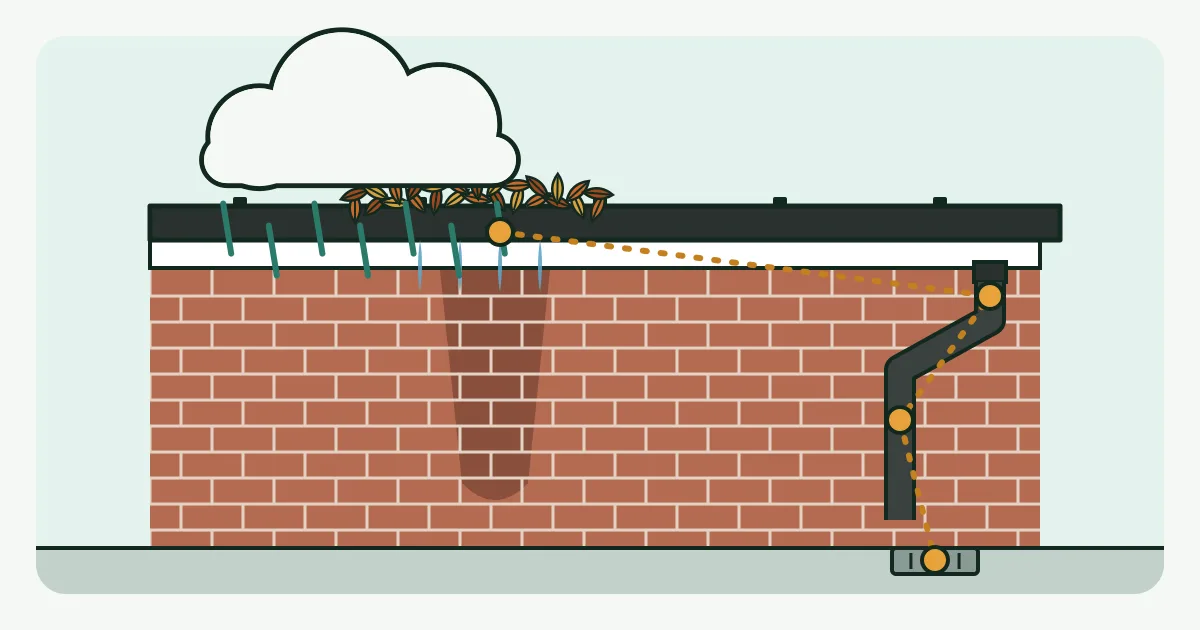
Water coming over the front of a gutter has one of a handful of causes. The list below runs from the most common to the least, which is also the sensible order to rule them out, because the cheapest fixes sit at the top.
Look at where the water is coming over before you decide. One spot and the rest dry points to an outlet or a joint. The whole run pouring points to silt or a lost fall. Water coming over only in heavy rain is a different story from a gutter that spills in drizzle.
1. A blocked outlet
Leaves, moss and silt pack down over the opening where the gutter drains into the downpipe. Water stops there and goes the only way it can. This is the cause in most cases, and blocked gutter clearing is the fix. Price guidance is in the blocked gutter clearing cost guide.
2. A run full of silt
Broken-down leaves, moss and tile grit settle as silt. Over a few years the channel narrows until it holds only a fraction of the water it was built for. The gutter can look clear from the ground and still be half full. A gutter clean is the answer, and the vacuum cleaning cost guide shows what to expect.
3. A blocked downpipe
If the outlet is clear but water still backs up, the pipe below may be blocked, most often at a swan neck, an offset bend or the shoe. Pour water in at the top. If it does not appear at the bottom, you have found it. Downpipe cleaning and repairs covers this, and the blocked downpipe cost guide gives the prices.
4. A blocked drain at the bottom
Sometimes the downpipe is fine and the gully or underground drain below it is not. The pipe fills to the brim and the gutter backs up behind it. A gutter cleaner cannot fix that, and a drainage specialist is the right call. Watch the gully during rain. If it brims over while the downpipe above is full, the drain is the problem.
5. A sagging run
A dip holds water, and when the dip fills the water spills over the lip before it ever reaches the outlet. Brackets that have bent, loosened or been placed too far apart are the usual reason. This is a gutter repairs job, and the sagging gutter repair cost guide covers it.
6. The fall has been lost
A gutter should drop gently towards its outlet. If it was fitted level, or has shifted, water sits where it should run. The giveaway is a run with standing water along its length after rain has stopped, not only in one dip. Re-hanging the run to a new fall is a repair rather than a clean.
7. A split or loose joint
A failed union lets water out at the seam, which looks like overflow because the water appears at one point on the way down. It usually drips instead of pouring. Replacing the gasket or union is a gutter joint and seal repair, with prices in the seal replacement cost guide.
8. Too much water for the system
This is the least common cause and the hardest to confirm from outside. A big roof draining to a single outlet, or a gutter too small for the roof area, can overflow in a downpour even when everything is clean and sound. Rule out items 1 to 7 first. If the gutter overflows only in the heaviest rain and is otherwise clear, ask a guttering or roofing specialist to look at the capacity rather than paying for more cleaning.
Overflow in one place, dry elsewhere: outlet or joint. Overflow along the whole run: silt or fall. Overflow with a full downpipe: pipe or drain. Overflow only in the worst storms and clear otherwise: capacity. Matching the pattern to the cause saves paying for the wrong visit.
What to do next
A ground-level look is a good first step, and how to tell if your gutters are blocked without a ladder describes what to watch. If you have just moved in and are not sure of the history, new-home gutter checks covers the first month. For a budget across all six services, try the gutter cleaning cost calculator. If birds are nesting in the gutter, wait: that is covered in a separate guide on nesting birds.
How to find out why a gutter is overflowing
- Watch where the water goes over
Stand safely on the ground during rain and note whether the water spills at one spot, along the whole run or only at a corner.
- Check the downpipe
Look for water running down the outside of the pipe or splashing at a joint, which suggests a blockage below the leak.
- Look at the gully
See whether the drain at the foot of the downpipe is full or brimming over, which would point to the drain rather than the gutter.
- Compare the line of the gutter
From a distance, look along the run for a dip or a section that sits lower than the rest.
- Decide which service fits
Match what you saw to the list above and ask for a quote for that job, naming the symptom to the firm.
Frequently asked questions
Why is my gutter overflowing when it looks clear?
The outlet or downpipe may be blocked where you cannot see it, silt may be filling the base of the gutter, or the run may have sagged so water sits in a dip. A clear-looking gutter is not always draining.
Why does my gutter only overflow in heavy rain?
Possible reasons are a partly blocked outlet, a slow downpipe, or too much roof draining to one outlet. If it is otherwise clean and sound, ask a specialist to assess capacity.
Can an overflowing gutter damage my house?
Repeated overflow can leave damp patches and algae on the wall, wet the fascia and eventually soak the ground by the foundations. It is worth fixing before winter.
How much does it cost to fix an overflowing gutter?
It depends on the cause. A blocked outlet is typically £60–£100, a full vacuum clean around £90–£130 for a two-storey house, and sagging-gutter repairs start around £90.
Ready to talk to a gutter cleaning specialist?
Get Free Quotes →