
What Is Gutter Cleaning?
Gutter cleaning is the routine removal of everything that collects in a property's gutters between visits — fallen leaves, moss knocked off the roof by birds and wind, seeds, twigs, and the fine sandy grit that concrete and clay tiles shed as their surface weathers. Left alone, that material breaks down into a dense, waterlogged silt that sits along the bottom of the gutter and gradually narrows the channel until rain has nowhere to go but over the front edge.
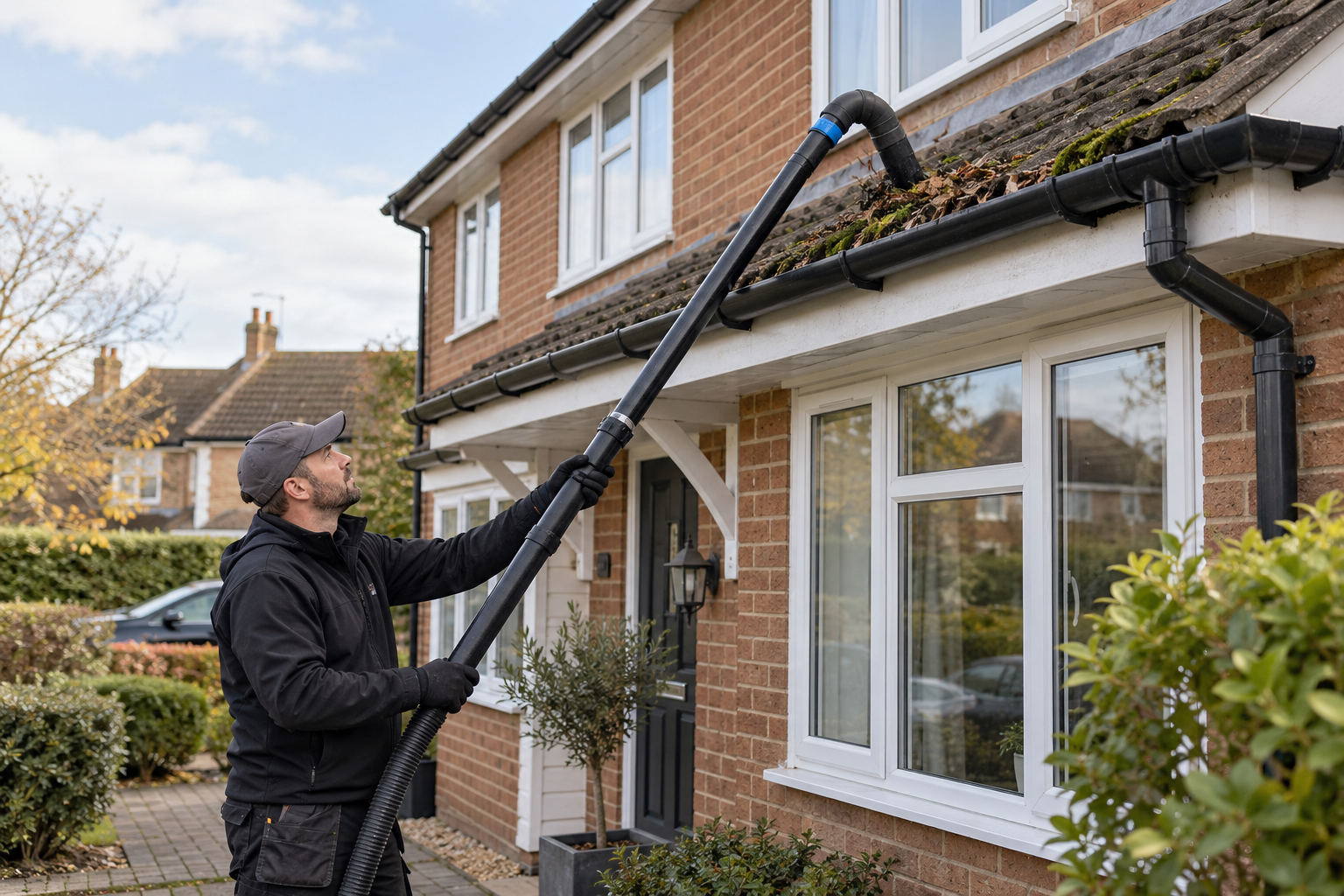
A professional clean covers every gutter run on the property, finishes at the outlets and should end with proof that water is draining freely. On a typical house without large trees nearby, one clean a year is enough; properties under mature trees or next to woodland often need a second visit in spring.
Signs You Need Gutter Cleaning
- It has been more than a year since the gutters were last cleared, or you cannot remember when
- Clumps of moss, grass or small seedlings are visible along the gutter line from the garden
- Rain spills over the gutter in steady showers, not just in a cloudburst
- Birds are regularly landing in the gutter to feed on seeds and insects in the debris
- Your roof has had moss treatment or a roof clean, which washes material straight into the gutters
- You are about to sell or let the property and want the roofline to pass a survey without comment
Gutter Cleaning Methods Explained
- Gutter vacuum from the ground — the most common method for houses up to three storeys. A high-powered wet-and-dry vacuum is connected to carbon-fibre poles with an angled nozzle, and a pole-mounted camera shows the inside of the gutter on a screen. There is no ladder against your fascia and no walking on the roof.
- Hand cleaning from a ladder or tower — still used where a vacuum struggles, such as heavily compacted silt that has set almost solid, very deep box gutters or gutters behind parapets. It is slower and needs careful attention to working-at-height safety.
- Cherry picker or mobile platform — for tall buildings, flat blocks or properties with conservatories that prevent a pole being used safely.
- Outlet and downpipe flush — after the gutter is cleared, water is run through each outlet to confirm the downpipe below is clear. If it is not, rodding or jetting may be quoted as a separate job.
What to Include When Asking for a Quote
The height of the gutters sets most of the price, so start with the house type and number of storeys, and mention any section that is higher than the rest — a gable end on a sloping site, a three-storey rear wing or a gutter above a basement light well. Say whether the back of the property can be reached through a side gate or only through the house, because gutter vacuums and their hoses need a clear route round.
Tell the company what sits directly under the gutters. Conservatory and lean-to roofs, bay windows, glass canopies and narrow flat-roof extensions all change where poles can be placed and how carefully debris has to be handled. If large trees overhang the roof, say what type they are: pine needles, sycamore keys and beech mast pack down differently and take longer to clear.
A good written quote for cleaning should list every gutter it covers — main roof, extension, garage, porch and dormers — and say whether the outlets are flushed and the downpipes tested. Ask whether the price includes bagging and removing the debris and whether you will receive before-and-after photos from the camera.
How Much Does Gutter Cleaning Cost?
| Property | Typical cost |
|---|---|
| Bungalow or small terraced house | £50 – £90 |
| Two-storey semi-detached or detached house | £80 – £140 |
| Large detached, three-storey or heavily blocked gutters | £130 – £180+ |
Extras such as conservatory gutters, garages and downpipe jetting are usually priced on top. Annual cleaning plans often cost less per visit than one-off bookings.
The Gutter Cleaning Process: What to Expect
- Walk-round. The operative checks access, protects anything fragile under the gutters and looks at the gutter profile and material.
- Before photos. The pole camera records the state of each run so you can see what was there.
- Clearing the gutters. Debris is vacuumed or scooped out along the full length, working towards each outlet.
- Outlet check. Water is run through each outlet and downpipe to make sure it drains away.
- Tidy up and report. Waste is bagged, the ground is swept, and you are shown after photos along with any loose brackets or leaking joints spotted.
Do I Need Planning Permission for Gutter Cleaning?
Cleaning existing gutters is usually routine maintenance and does not require planning permission or building regulations approval. If work on a listed property would change historic fittings, check with the local planning authority first. Anyone working from a ladder or platform should follow the HSE's work-at-height guidance; a ground-based vacuum can avoid working at height where access allows. If birds are nesting in the gutters, an active nest is protected by law and should be left undisturbed while in use.
How to Choose a Gutter Cleaning Company
- Do they hold public liability insurance, and does it cover working at height?
- Will they use a vacuum from the ground, or will ladders rest against the gutters or fascia?
- Does the price include every gutter on the property, including outbuildings?
- Will they test the downpipes and tell you if one is blocked?
- Do they provide before-and-after photos or camera footage?
- Do they offer a reminder or discounted price for an annual visit?
Frequently Asked Questions
How often should gutters be cleaned?
Once a year is enough for most UK homes, ideally in late autumn after the leaves have fallen. Properties under large trees or near woodland may need a second clean in spring.
Can gutters be cleaned from the ground?
Yes. Most companies now use a gutter vacuum with extendable carbon-fibre poles and a camera, which reaches gutters up to three storeys high without a ladder.
Do I need to be at home for my gutters to be cleaned?
Usually not, as long as the company can reach every side of the house. Many send before-and-after photos when the job is finished.
How much does gutter cleaning cost?
Most domestic gutter cleans cost between £50 and £180, depending on the size and height of the property and how blocked the gutters are.