
What Are Gutter Joint and Seal Repairs?
Gutter joint and seal repairs stop the drips that come from the connections in a gutter run rather than from the gutter itself. Plastic guttering is joined with unions, corner angles, stop ends and running outlets, each containing a rubber gasket that the gutter length clips against. Over time those gaskets harden, shrink and crack with UV and frost, and thermal movement — plastic gutters expand and contract noticeably between a hot summer afternoon and a frosty night — can pull a length partly out of its fitting. On cast iron gutters, the joints are bolted and bedded on sealant that eventually dries out and lets water weep through.
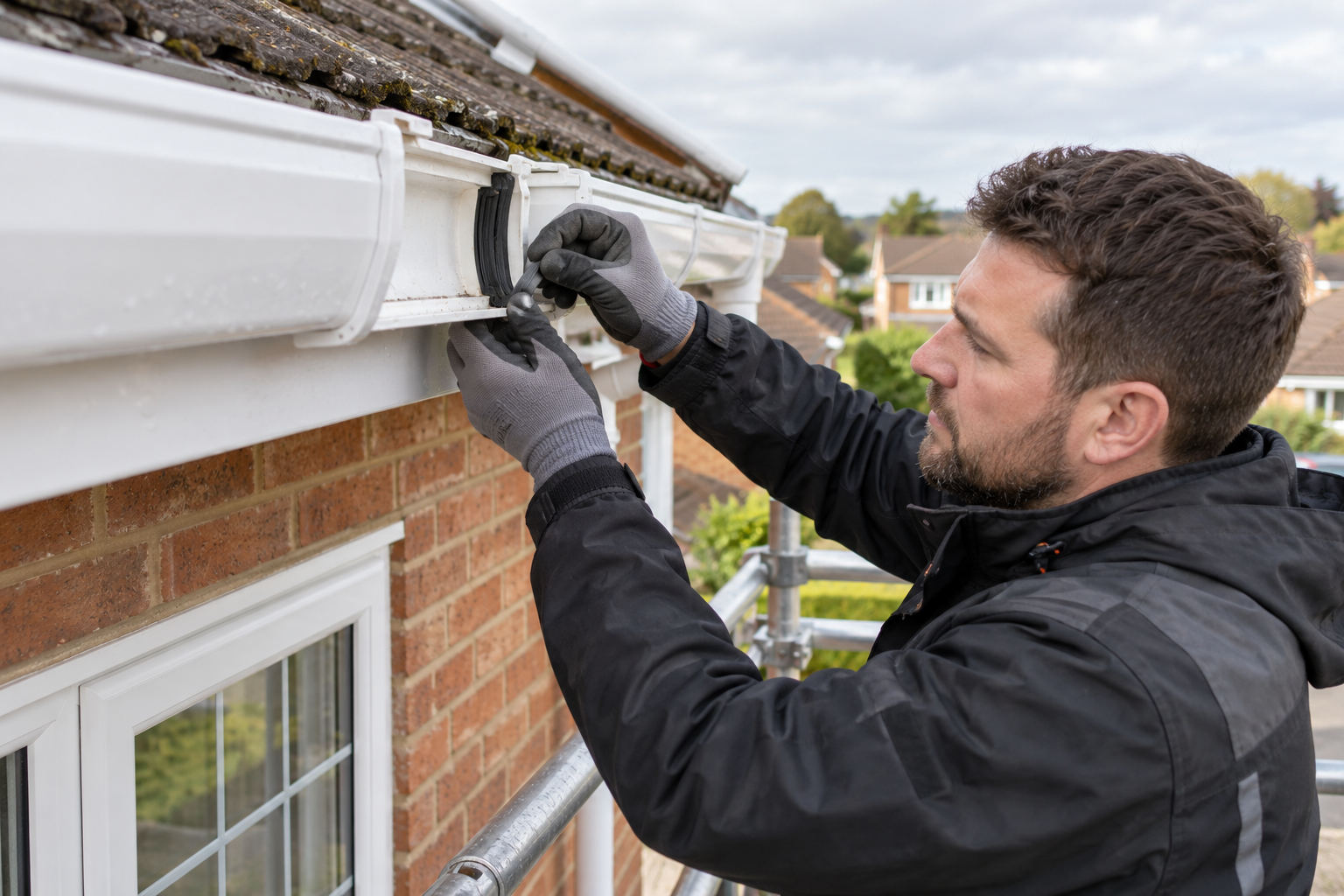
A single leaking joint is one of the cheapest gutter faults to fix, but it is also easy to leave too long. The drip lands in the same place every time it rains, staining brickwork, eroding mortar and rotting timber below.
Signs You Need a Joint or Seal Repair
- Drips continue from one point of the gutter for a while after rain has stopped
- A dark stain, moss or algae patch sits on the wall directly under a union or corner
- A line of rust or green staining runs from a joint on cast iron guttering
- You can see a gap where a gutter length has pulled back from its fitting
- Water drips onto a path, windowsill or conservatory roof from the same spot each time
- The leak gets worse in cold weather and eases off in summer, typical of shrinking plastic
Joint and Seal Repair Options Explained
- Clean and re-seat — the fitting is unclipped, the gasket and gutter ends cleaned of silt, and the length pushed back to the correct insertion mark so it seals again. This works when the gasket is still soft.
- Gasket replacement — where the rubber seal is perished, a new seal is fitted or the union is replaced with a new one in the same profile.
- Fitting replacement — cracked unions, corner angles, stop ends or running outlets are swapped for new parts. Matching the original manufacturer's profile matters, as different brands' fittings often do not mate cleanly.
- Cast iron joint re-bedding — the nut and bolt is removed, the joint separated and cleaned back to bare metal, then re-bedded on a gutter sealant or mastic and re-bolted.
- Sealant patching — a gutter sealant can be applied inside a joint as a short-term fix, but on plastic gutters it rarely lasts, because the joint still needs to allow for thermal movement.
What to Include When Asking for a Quote
Count the leaking points and say exactly where each one is — a corner at the back, the union above the front door, the stop end at the end of a run. Note whether drips come from the joint itself or from the gutter just beside it, because water tracking along the underside of the gutter can make a leak look further along than it really is. A short video of the drip during rain is often the best evidence.
Name the gutter type if you can: a common uPVC half-round, a square-line or ogee profile, a brand name moulded on the fittings, or cast iron. Fittings from different plastic ranges look similar but rarely seal properly together, so the specialist needs to know what to bring. If a gutter length has visibly pulled out of a union, mention it; that suggests the bracket spacing or fall also needs attention.
Ask whether the quote is for re-seating the existing fitting or for a new union or gasket, and whether the specialist will check the other joints on the same run while the ladder or platform is in place. For cast iron, the quote should cover separating, cleaning and re-bedding each joint, not just applying sealant over the outside.
How Much Do Gutter Joint and Seal Repairs Cost?
| Repair | Typical cost |
|---|---|
| Re-seat or replace one plastic union or corner | £60 – £100 |
| Several joints, stop ends or outlets on one visit | £100 – £160 |
| Cast iron joints re-bedded, or high-level access | £160 – £220+ |
Joint repairs are often added to a gutter clean for less than a separate call-out. If most joints on a long run are failing, ask whether replacing that run would be better value.
The Joint Repair Process: What to Expect
- Pinpoint the leak. Water is run through the gutter to confirm which joint is leaking and why.
- Clear the section. Silt and debris are removed from around the joint so it can be opened cleanly.
- Open and inspect. The fitting is unclipped or unbolted, and the gasket, gutter ends and fitting are checked for damage.
- Re-seal. The joint is re-seated, given a new gasket or fitting, or re-bedded on sealant for cast iron.
- Test. Water is run again to confirm the joint stays dry, and the neighbouring joints are checked.
Do I Need Planning Permission for Joint Repairs?
No. Re-sealing or replacing gutter fittings like for like is routine maintenance and needs no planning permission or building regulations approval. On listed buildings, cast iron joints should be repaired with matching materials rather than replaced with plastic fittings, which could need listed building consent; your local planning authority can advise if you are unsure.
How to Choose a Specialist for Leaking Joints
- Can they identify your gutter brand and supply matching fittings?
- Will they replace perished gaskets rather than just applying sealant over the joint?
- Do they have experience re-bedding cast iron joints, if that is what you have?
- Will they check the other joints and the bracket spacing on the same run?
- Do they guarantee the repaired joint for a set period?
Frequently Asked Questions
Why does my gutter leak at the joints?
Usually because the rubber gasket has perished, debris has built up in the joint, or the gutter has shrunk in cold weather and pulled out of the fitting.
Can I just use sealant on a leaking gutter joint?
Sealant can stop a drip for a while, but on plastic gutters it often fails because the joint needs to move with temperature. Replacing the gasket or fitting lasts longer.
Can cast iron gutter joints be resealed?
Yes. The joint is unbolted, cleaned back, re-bedded on a suitable sealant and bolted together again.
How much does it cost to fix a leaking gutter joint?
Most joint and seal repairs cost between £60 and £220, depending on the number of joints, the gutter material and how easy they are to reach.